🌍 Expanding into new markets no longer requires creating entirely new marketing campaigns. The real challenge is adapting existing creative assets quickly, accurately, and at scale.
For modern marketing teams, localization is often a production problem rather than a design problem.
Key Takeaways
- Localized campaigns often require hundreds of graphic variations.
- Manual Photoshop editing slows down international marketing efforts.
- Reusable templates reduce creative duplication.
- Variable data workflows simplify content replacement.
- Batch production helps teams launch campaigns faster across multiple regions.
Introduction
Launching a successful marketing campaign in one country is difficult enough. Launching the same campaign across multiple countries introduces an entirely new layer of complexity.
Marketing teams must update headlines, pricing, promotions, languages, imagery, and branding variations while maintaining visual consistency.
The design itself is often finished early. The real workload begins when localization starts.
Every market needs its own version.
Every language requires text updates.
Every region may require different product visuals, offers, or promotional messaging.
This is where production efficiency becomes critical.
Industry Problem
Many organizations still localize marketing graphics manually.
Designers duplicate PSD files, replace text layers, update product images, export assets, and repeat the process for every language.
A campaign targeting ten regions may require:
- Ten language versions
- Multiple ad sizes
- Regional product variations
- Market-specific promotions
- Platform-specific exports
What begins as a single campaign can quickly turn into hundreds of design files.
The creative concept remains identical, but the production workload multiplies.
Common Mistakes
- Creating separate PSD files for each language.
- Copying and pasting translated text manually.
- Replacing images one design at a time.
- Managing localized assets through duplicated templates.
- Exporting every variation individually.
These workflows create maintenance challenges and increase the likelihood of inconsistencies between regions.
Productivity Impact
Localization often consumes far more production hours than expected.
Creative teams spend less time designing and more time updating content.
Simple text changes can trigger dozens of manual revisions across multiple file versions.
The larger the campaign becomes, the more difficult it becomes to maintain speed and accuracy.
This slows campaign launches and creates additional review cycles.
Better Workflow
Leading marketing teams approach localization differently.
Instead of creating separate PSD files for every region, they build reusable master templates.
Content becomes data.
Design becomes structure.
Translations can be stored in TXT files or CSV datasets.
Regional images can be stored in organized folders.
Templates remain unchanged while content updates automatically.
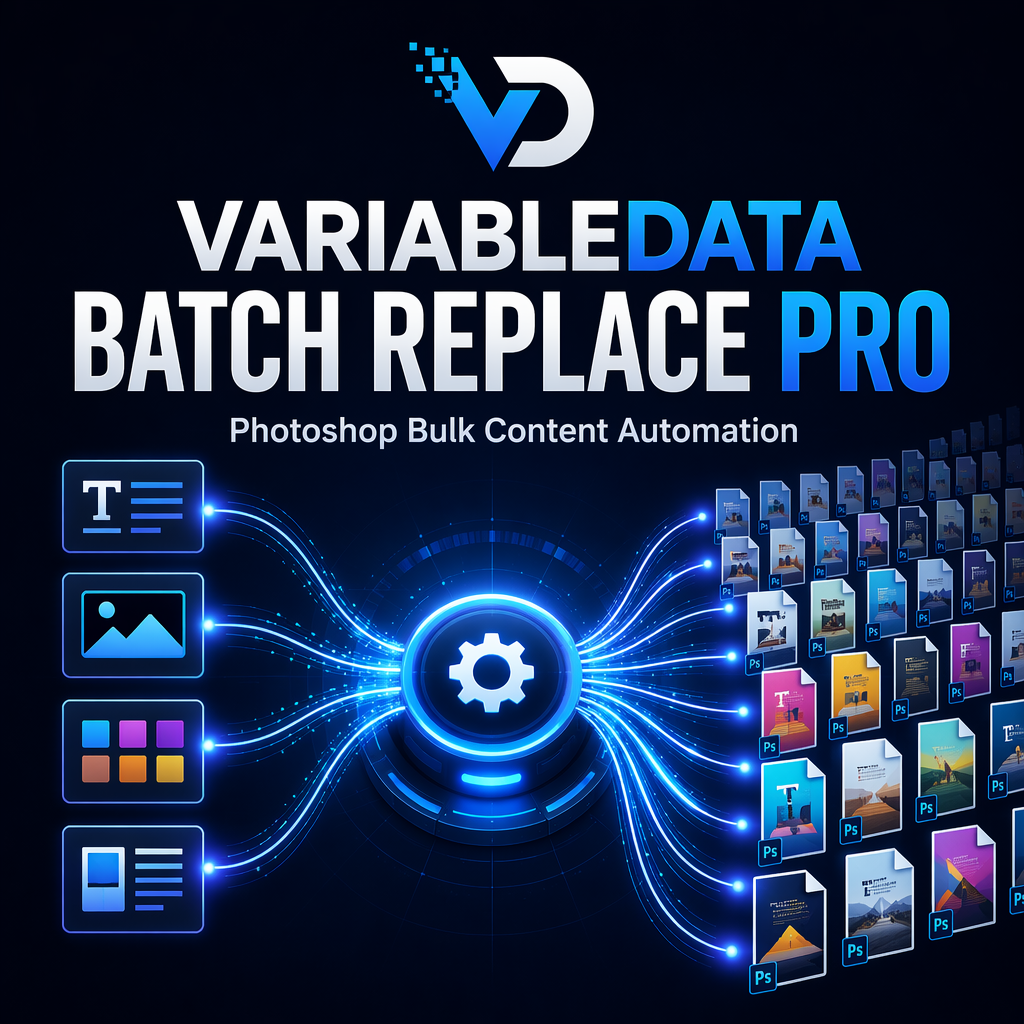
This workflow allows teams to generate large numbers of localized assets from a single design system.
Automation Benefits
- Faster multilingual campaign production
- Consistent branding across regions
- Reduced manual editing
- Simplified review processes
- Faster deployment timelines
- Scalable international marketing operations
For organizations managing multiple markets simultaneously, these benefits become increasingly valuable.
Case Example
A software company launches a seasonal promotion across twelve countries.
The campaign requires:
- 12 language versions
- 3 advertising sizes
- Region-specific pricing
- Localized screenshots
Without automation, designers must manually create dozens of graphic variations.
With a variable data workflow, translated text can be imported directly from CSV files while localized images are pulled from designated folders.
The same PSD template generates every required variation automatically.
The result is a significantly more scalable production workflow.
Pro Tip
Keep all localized content in structured CSV files rather than embedding translations directly into PSD templates. This makes future updates dramatically easier and improves collaboration between marketing and localization teams.
Manual Localization vs Automated Localization
| Task | Manual Workflow | Automated Workflow |
|---|---|---|
| Translations | Manual Editing | CSV Driven |
| Image Updates | Individual Replacement | Batch Replacement |
| Campaign Variations | Duplicated PSD Files | Reusable Templates |
| Exports | One by One | Bulk Export |
| Scalability | Limited | High Volume Production |
FAQ Section
Why is localization difficult in Photoshop?
Because every language version typically requires multiple text and image updates across many design files.
Can localization be automated?
Yes. Structured content and reusable templates allow large portions of the workflow to be automated.
Can different images be used for different regions?
Yes. Image folders can provide region-specific visual assets while maintaining the same template structure.
Can multiple templates be processed at once?
Yes. Multi-template workflows are particularly useful for large international campaigns.
Scale International Campaign Production
Localized marketing should not require rebuilding the same design repeatedly. A structured variable data workflow helps teams produce multilingual campaign assets faster while maintaining consistency across every market.
Conclusion
As businesses expand internationally, localization becomes a critical operational challenge. The issue is rarely design quality. More often, it is production scalability.
Reusable templates, structured content, batch image replacement, and automated export workflows help marketing teams move faster without sacrificing consistency.
By treating localization as a data-driven production process rather than a file-by-file editing task, organizations can support more markets, launch campaigns faster, and reduce repetitive creative work.